
AI can read the accounts, but does it understand what the numbers mean?

Aage Thorsen
CTO
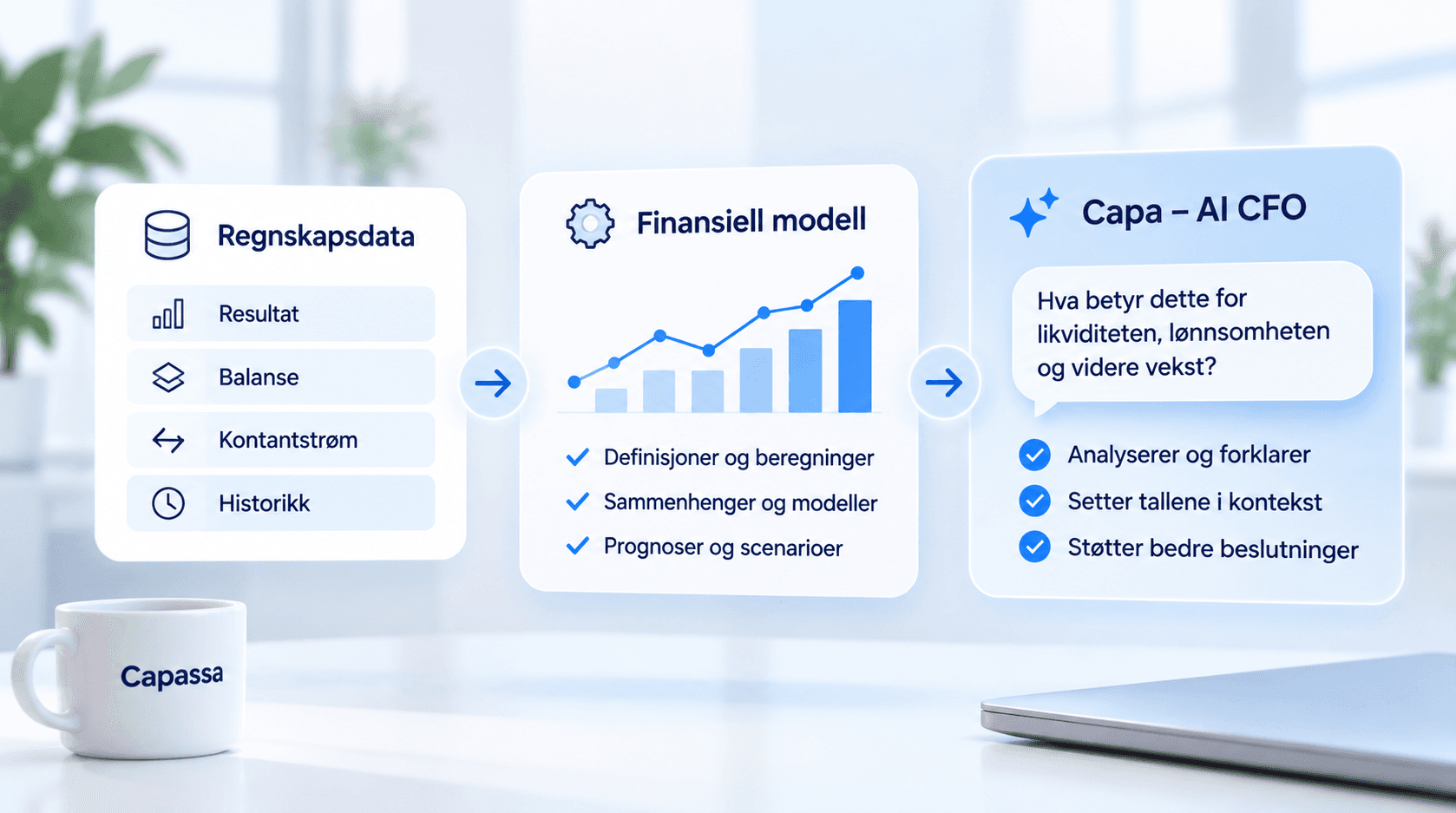
Imagine a managing director asking the AI agent: "What was our revenue in September?" The agent retrieves the number from the accounting system and answers. Later she opens a dashboard, looks at the same month and gets a different number. Both can be correct. One may include accruals and the other not, one may show amounts including VAT and the other excluding it, or they may be based on different data sources and filters. The problem isn't necessarily that someone calculated wrongly, but that nobody said which definition was used. Two numbers can each be correct within their own definition and still give a misleading picture when the definition isn't stated.
This is the distinction I think gets too little attention in the discussion about AI and financial management: the difference between having access to the numbers and understanding what they represent.
MCP opens the door, but what's inside?
In my previous article, MCP is plumbing, not intelligence, I wrote about how the Model Context Protocol makes it easier for AI agents to communicate with external systems. By connecting an agent to an accounting system, it can access transactions, income statements and balance sheets, and the user can ask questions directly of the accounts and get answers in seconds. That's impressive, but an integration protocol doesn't in itself make the agent financially intelligent. An integration with the accounting system isn't necessarily an integration with the company's financial reality, and if the agent only has access to historical accounting data, that's primarily what it can analyse.
Correct numbers require correct definitions
When we develop AI for financial management, the system has to know what the numbers represent. What's included in revenue? How is gross profit calculated? Which periods are being compared, and how are VAT and accruals handled? It may sound like detail, but if different parts of the solution use different definitions, we get different answers to the same question, and that isn't good enough when the numbers are used for decisions. The same applies to key figures such as working capital and DSO, meaning how many days customers take on average to pay.
Let the system calculate. Let the AI understand.
This is perhaps the most important choice we've made at Capassa: What should the language model do, and what should the rest of the system do? Our answer is that the language model isn't the financial system. It should understand the question, retrieve numbers, explain them and ask follow-up questions, while the numbers themselves come from the system around it. The accounting data is structured according to the Norwegian standard chart of accounts, key figures are calculated according to defined rules, and dashboards, reports and Capa, our AI CFO, all build on the same definitions and calculations. That gives us a shared basis of numbers that can be verified, regardless of how the information is presented to the user. It doesn't remove every difference, because update times, period selection and filters can still affect the result, but the differences can be explained and traced.
The same applies when the question is about the future. If you ask Capa to add a new employee from August, it isn't the language model doing the calculation. It's the budget module that calculates salary, holiday pay, pension and employer's contributions month by month, and the result is presented as a proposal you have to approve before anything changes.
In my view, this is a requirement for any AI agent used in financial management: The numbers must come from rule-based calculations, and every number must be traceable to its source. An agent that has only been given access to historical accounting data through MCP doesn't meet this requirement on its own, however good the language model is. That doesn't mean the model is unimportant. Much of the potential lies in its ability to combine information, reason and understand context, but then we have to be clear about what is what.
We have to distinguish clearly between what we know, what we've calculated, what we assume and what we recommend.
An AI CFO also has to know what it doesn't know
Even with correct numbers and rule-based calculations, the agent primarily understands the accounts, not necessarily the business. Imagine an AI CFO seeing that liquidity is expected to fall in March. It can calculate the development and point to which items affect it. But it doesn't necessarily know that a large customer has warned of a late payment, that the company is planning new premises or that management has made a decision that isn't in the budget. That kind of information isn't always found in historical accounting data. It may be in the budget, in the company's plans or with the people who run the company.
A good AI CFO therefore has to be able to combine accounting data, budgets and other relevant information, and when something is missing, it has to ask follow-up questions rather than draw firm conclusions. It shouldn't present a hypothesis as a documented fact, and it has to be clear about the assumptions the analysis is built on.
I think the next phase of AI for financial management will be less about how many data sources an agent can be connected to, and more about how well it understands the connections between them and how clearly it shows what it has used.
MCP can open the door to a company's financial history. But the difference between an AI agent that can read the accounts and an AI CFO that can help run the business lies in understanding what the numbers mean.
More posts
From numbers to the whole picture: Why AI must remember the right things, not the most
What will matter is not how much information an AI agent has access to, but how well it understands the connection between the information, the decisions we make and what we want to achieve. Anthropic's research suggests that an agent has to choose what it remembers, and check that what it remembers is still true.
You can go bankrupt while making a profit. Do you know when the money runs out?
A profit and loss budget shows whether you expect to make money. A cash flow budget shows whether the money is in the bank when the bills are due. When you change your plans in the budget, you need to see both, and Capa can show you which months could become difficult.
Get new analyses in your inbox
One new post a week, never more. No product ads.
Curious about how Capassa works in practice?
Get in touch