
No customer should have to repeat themselves
When the whole customer dialogue sits in one place, everyone on the team meets the customer with full context. Every conversation builds on the last one, whoever picks up the phone.
Book a demo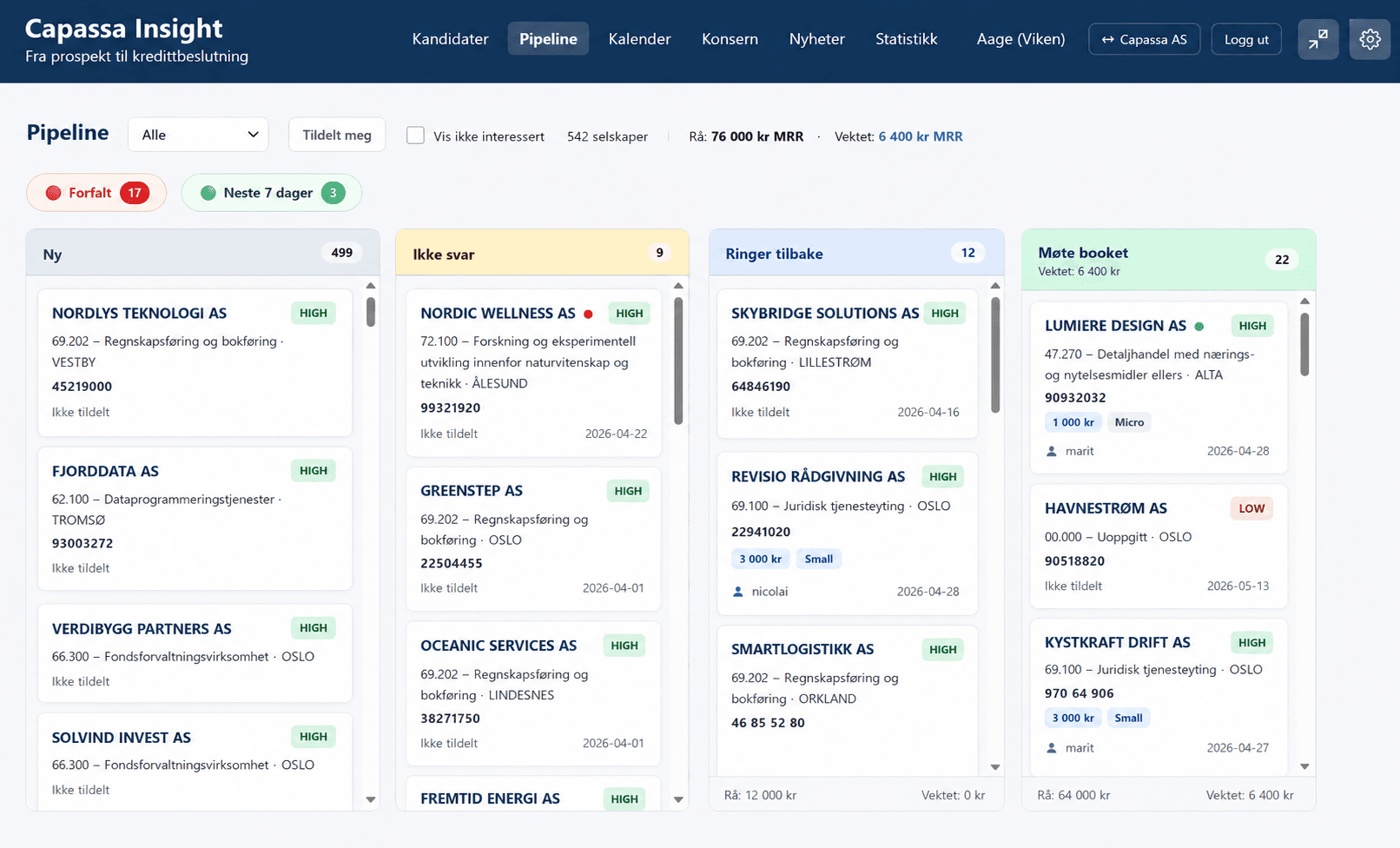
The customer has to start over with every new person who answers.
The meeting booker knows the first conversation. The salesperson knows the last meeting. The proposal is in Outlook, the minutes are in Teams, and the notes are somewhere else entirely.
When the customer gets in touch again, whoever answers has to start from scratch, no matter how much has already been said.
The result is that the customer repeats themselves, follow-up becomes a matter of chance, and new colleagues have to begin all over again.
Everything the team knows.
On one customer card.
Everything lands on the customer card
Company information, contacts, meetings, transcripts, phone calls, emails, notes and contracts are gathered automatically in one place.
Access follows the role, not the person
The history sits on the customer card, not only in the head of whoever originally spoke to the customer. Whoever administers the account decides which role each person is given, and therefore what information they can see.
AI knows the history
Because AI has access to the dialogue, it can summarise earlier communication and suggest what should happen next.
The next person carries on where the last one stopped
Whether that is a new salesperson, a colleague covering for someone, or you yourself after a break in the dialogue.
You feel the difference when someone other than you meets the customer.
A new salesperson takes over a customer. Instead of reading through months of emails and meeting minutes, AI summarises the earlier dialogue in seconds. The next follow-up email can be written from what was actually said, rather than guessed at.
The history is not just stored. It is put to use, so the next person always starts where the last one stopped.
See where every customer is in the process.
The whole team sees the same pipeline, from first contact to won customer. Nobody has to ask a colleague for an update, it is already there on the customer card.
One pipeline. The whole team sees the same picture.
The meeting takes care of the notes itself.
Nobody has to sit and write minutes while the meeting is going on.
Automatic transcription
The meeting is transcribed automatically while it takes place.
AI summarises
Get a short summary of what was said and agreed, without reading through the full transcript.
Straight into the task list
Tasks that come up during the meeting are added to a task list automatically, ready to be followed up.
You do not need to take notes. The meeting does it for you.
Everything in one place.
The customer card gathers company information, contacts, activities, meetings, transcripts, phone calls, emails, notes, contracts, news and pipeline, so the whole team always has the same complete history to hand.
Who is this built for?
In-house sales and account teams
Everyone on the team meets the customer with the same context, whoever answers the phone or takes over a dialogue along the way.
Sales and meeting booking agencies
Manage the customer dialogue for several clients from one platform, with the same shared history that in-house teams have for their own customers.
Sales leaders and growth companies
See when a customer relationship is fragile, for example when only one salesperson knows the customer well, and make sure that knowledge does not disappear when someone changes role.
Make sure no customer has to repeat themselves.
Insight gathers the whole customer dialogue in one place, so everyone on the team meets the customer with full context, whoever answers.
Book a demoFrequently asked questions
Do we have to enter everything by hand for the customer card to fill up?
No. Meetings, phone calls, emails and transcripts are gathered on the customer card automatically as the dialogue happens. You do not need to copy information from several systems into one — the customer card builds itself from the work the team is doing day to day anyway.
What happens when a new salesperson takes over a customer?
All the information sits on the customer card, so the new salesperson quickly understands where the customer stands. AI helps out, so the next follow-up builds on what has actually been said before instead of starting from nothing.
Is this just a contact register, or something more?
Something more. A traditional contact register stores names and phone numbers. The customer card in Insight gathers the whole dialogue — meetings, emails, calls, notes and contracts — and AI puts it to use to summarise and suggest the next step, rather than simply keeping it on file.
Can several clients be managed from the same account?
Yes. Sales and meeting booking agencies can manage several clients from one platform, with a separate customer overview and history for each of them. You switch between clients in one click, without logging in and out of separate accounts.
Does the whole team see the same information, or only the person who entered it?
That depends on each person's role, not on who originally entered the information. Whoever administers the account decides which role each person is given, and therefore what information they can see. The point is the same either way: you do not have to have noted everything yourself, because the right information is available to the roles that actually need it.
Does this work together with the rest of Capassa Insight, such as Bookr?
Yes. The customer card is part of the same platform. Candidates you find in Bookr carry over into the CRM when the dialogue starts, without you having to move information by hand between separate systems.