
73% of CFOs believe AI will improve the business. But what does ‘improve’ actually mean?

Marit Wetterhus
Chief Executive Officer
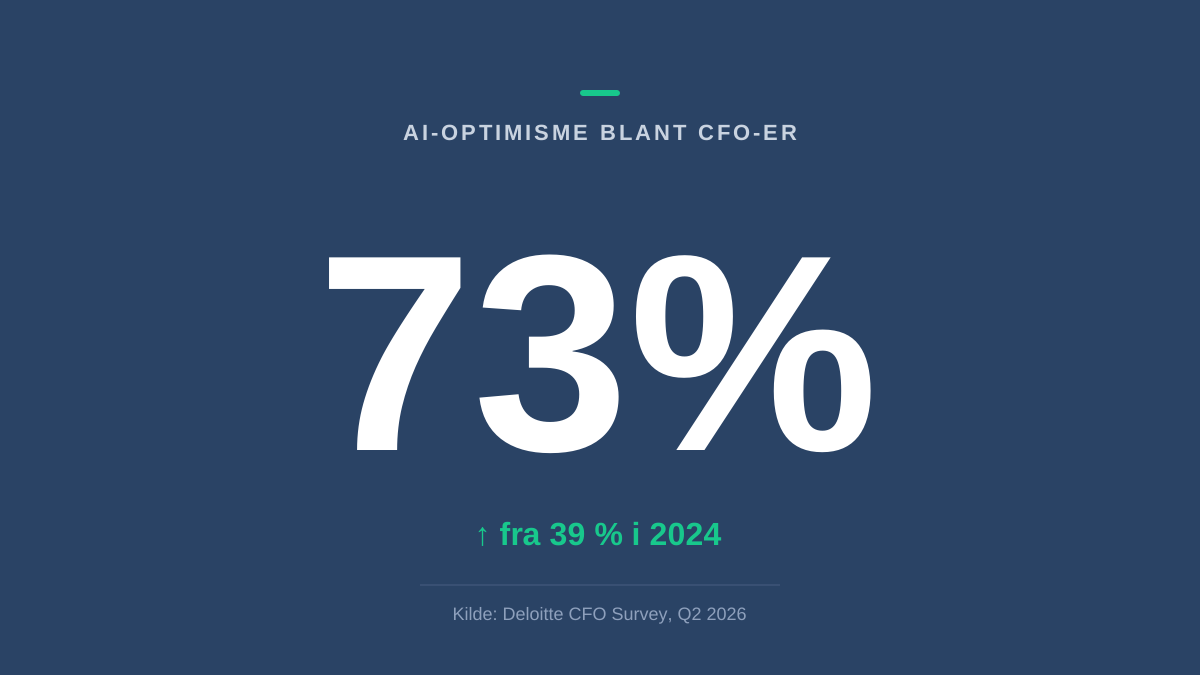
A new survey from Deloitte shows that optimism about artificial intelligence is rising fast among UK CFOs. Fully 73 per cent believe AI will improve business performance. Just two years ago the figure was 39 per cent. The direction is clear: AI has gone from a technology many were curious about to something most now expect to create value.
What is interesting, however, is not that optimism is rising.
What is interesting is what that optimism actually rests on. Because what does it really mean for AI to "improve the business"? Does it mean that people become more productive? That costs come down? That reports are produced faster? Or does it mean that the business genuinely takes better decisions? I think the last question is the most important one, and at the same time the one we talk about least.
Technology does not create value on its own
Recent years have brought a steady stream of new AI tools. Many of them are impressive. They can write text, analyse data, build presentations and automate tasks that used to take hours. It is easy to see why optimism is rising. But technology does not create value on its own. Value appears only when the technology changes the way the business is run.
This is an impression rather than a quantified finding so far, but it is a pattern we recognise: AI makes it quicker to produce an answer, yet it does not necessarily make the business quicker to make up its mind.
It is not necessarily more analysis that a business needs. It is a better basis for decisions.
Optimism has risen, but the demands have not eased
In its survey, Deloitte points out that CFOs expect AI to contribute to better results. That is a development I expect to continue. At the same time, the same survey shows that cost control remains one of the highest priorities for finance leaders. In other words: optimism about AI has risen, but the demand for documented value has not eased.
I think that will be the real test over the next few years.
The real test
Businesses will not succeed because they use the most AI. They will succeed if AI helps them prioritise better, reduce uncertainty and take wiser decisions. If the technology merely makes existing processes slightly faster, the gain is limited. If, on the other hand, it leaves the leadership better able to understand the business and act sooner, the value is of an entirely different order.
That is why I think we should be careful about measuring AI initiatives by how many tasks are automated. The more important question is perhaps a different one: which decisions do we take better today than we did before we adopted AI? Because if we cannot answer that question, it is hard to know whether the technology has actually improved the business, or merely made it slightly faster.
Get new analyses in your inbox
One new post a week, never more. No product ads.
Curious about how Capassa works in practice?
Get in touch