

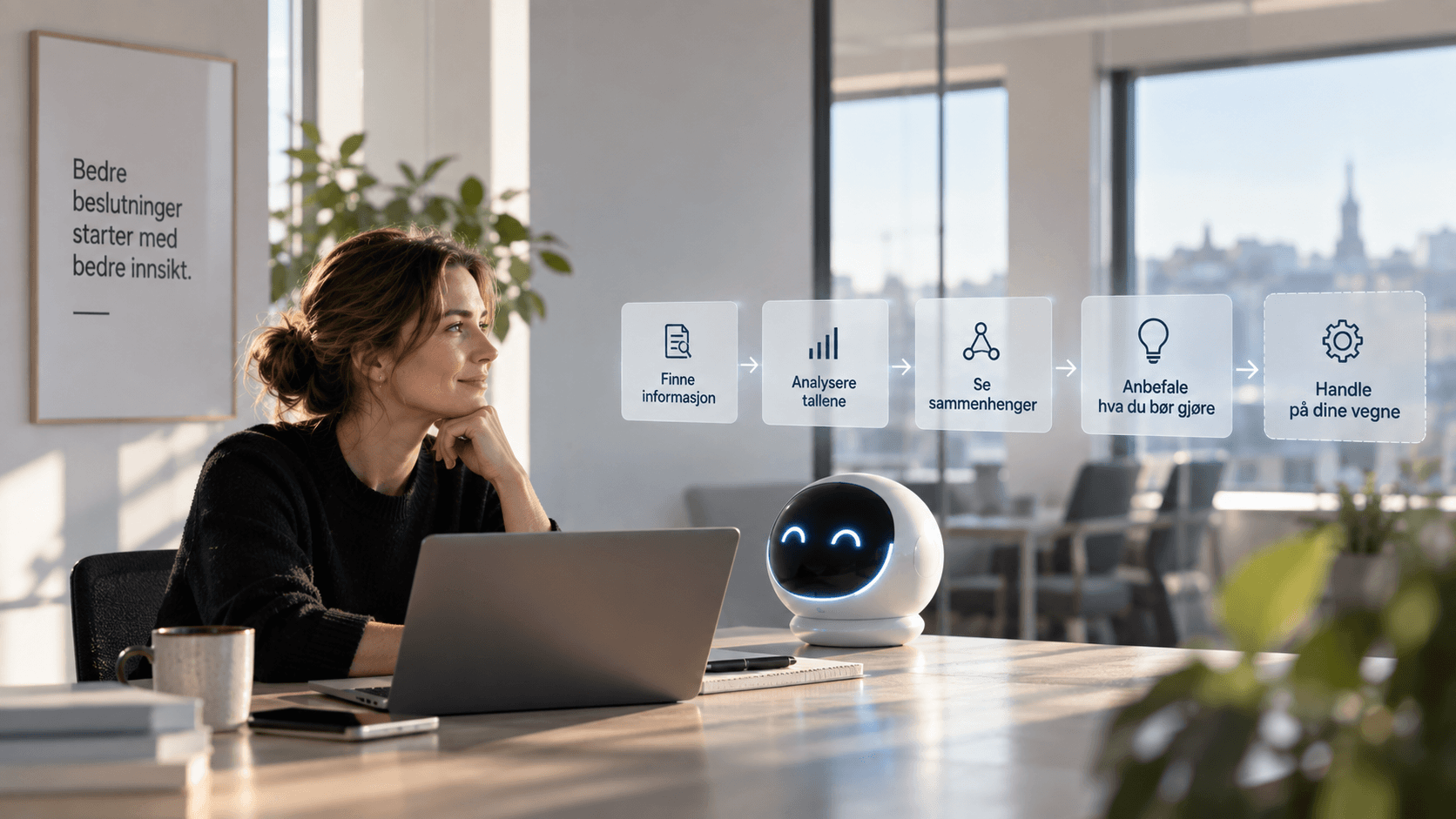
We've spent a lot of time asking what AI can do. Can it write the text? Find the information? Analyze the numbers? Spot something we've overlooked ourselves? But as the technology gets better, a harder question emerges: how much are we actually willing to let AI do for us? Because using AI as a tool is one thing. Handing over parts of the work to it is something else entirely. When AI finds information for us, we can still judge for ourselves what that information means. But once AI starts analyzing, spotting patterns, and recommending what we should do, we're also shifting part of the judgment from the human to the technology. And that's when something interesting happens.
The question is no longer just what AI can do, it's whether we trust what it does.
- What would it take for you to be comfortable with an AI not just finding the numbers, but analyzing them for you?
- What would it take for you to trust the recommendation it gives?
- And what would it take for you to one day let it act on your behalf?
The more responsibility we want to give AI, the more important the answers to these questions become. And maybe there's a paradox right here. Because what looks at first glance like limits on AI, safety, control, clear boundaries, might turn out to be exactly what makes it possible to let AI do more.
From information to judgment
We're in the middle of this exact question ourselves. When we started building AI into Capassa, much of the value was relatively easy to understand. AI could help surface information, explain numbers, and make existing work faster. But over time, Capa has taken on a different role. She can analyze financial data, spot patterns, catch anomalies, and help the user understand what's actually happening in the business. That might sound like a natural next step, and technologically it is. But in principle, it's a fairly big leap.
Because there's a difference between saying: "Here are your numbers."
And: "Here's what I think you should pay attention to, and here's why."
The moment AI goes from retrieving information to interpreting it, the demands we need to place on the technology around it go up too.
Trust can't be an afterthought
If we're going to trust an analysis, we need to know where the information comes from. We need to know what data the AI has access to, and what it doesn't. We need to be able to control who gets to see what. We need to be able to trace what happened. And once AI eventually gets the ability to take actions, it needs to be clear which actions it can carry out on its own and which require human approval. That means access control, traceability, logging, data control, and clear limits on autonomy. Not because we want to limit what AI can do, but because we want to be able to trust it when it does more.
That's why, for us, the AI isn't a standalone system free to send customer data off to random external services. It operates within controlled boundaries inside Capassa's own systems, with defined access levels and security mechanisms. It's not the most spectacular part of AI, but it might be one of the most important.
BCG turns the problem on its head
That's why I find a recent article from Boston Consulting Group interesting. BCG addresses exactly this paradox: many organizations experience governance as something that slows AI development down. More rules. More approvals. More controls. But BCG argues we might be thinking about it backwards. Good AI governance shouldn't primarily make AI harder to use. It should make it possible to use more AI, safely. When an organization has decided in advance which data an AI can use, which decisions it can make, what gets logged, when humans need to be involved, and where the limits are, it actually becomes easier to give AI more responsibility. Governance then stops being just a compliance question.
It becomes an enabler, and the more agentic AI becomes, the more important I think that distinction will get.
From assistant to agent
Most of us have so far encountered AI as an assistant. We ask. AI answers. But agentic AI changes that relationship. An agent can be given a goal, carry out several tasks, use different tools, and come back with a result without a human needing to instruct every single step. That opens up an enormous space of possibility, but it also changes the question we need to ask.
It's no longer enough to ask: can AI do this?
We also need to ask: should AI be allowed to do this alone?
Sometimes the answer will be yes, while other times we'll want AI to analyze and recommend, while the human makes the decision. And in some situations, AI shouldn't have access at all. So the interesting challenge isn't maximizing autonomy, it's finding the right level of autonomy.
Maybe trust becomes the real competitive advantage
We talk a lot about how intelligent AI models are becoming. How fast they reason. How many tasks they can solve. How good the agents are getting. But as the technology keeps improving, I think another question becomes just as important: how much do we dare hand over to it? Because if we don't trust the AI, it doesn't matter how intelligent it is. We'll still end up checking everything it does. Double-checking the analyses. Having a human approve every single step, and then most of the gain disappears. That's why I think safety and control are going to become far more than a compliance question in the AI era. They're going to become a precondition for capturing the value of the technology. The best AI, then, might not be the one that gets to do the most, but the one we dare to let do more.
More posts
We knew something was off. Capa found out what.
We found an error in our own numbers and handed the problem to Capa. She found it, but the interesting part was something else: how she discovered it, understood it, and followed up afterward. That's the loop we're building into Capa, not another chatbot.
Your AI is not the problem
OpenAI's chief scientist is warning against recursive self-improvement. Anthropic reports that Claude now writes more than 80 percent of its own code. But this isn't about the AI assistant you use at work, it's about something else entirely, and the difference matters.
Get new analyses in your inbox
One new post a week, never more. No product ads.
Curious about how Capassa works in practice?
Get in touch