
AI does not make your business smarter. Your decisions do.

Marit Wetterhus
CEO
We have been asking the wrong question.
For the past couple of years, the debate has been about how AI can make us more efficient. How to write faster. How to automate more tasks. How to cut costs.
Those are useful questions. But maybe not the most important ones.
A recent research paper in Frontiers in Artificial Intelligence points to something far more interesting: AI does not produce better results because it automates more. It produces better results when it enables the business to make better decisions. The researchers call this strategic intelligence, the ability to understand the situation you are in, see connections, and make good decisions based on them.
That should give every SME leader pause.
The biggest challenge is not a lack of data
Most businesses are already drowning in information. The accounting system holds thousands of transactions. The CRM system tells you what is happening in sales. The bank account shows the cash flow. Reports are produced every month.
Yet many leaders are left with the same questions:
- Can we afford to hire?
- Is our growth profitable?
- What will liquidity look like in three months?
- Which customers actually create value?
- When should we invest, and when should we wait?
The problem is rarely that the information is missing. The problem is that it arrives too late, is scattered across several systems, or never turns into action.
We recognise this from Norwegian SMEs. We have seen the same pattern again and again among the leaders we talk to: all the sources exist, accounting, banking, CRM, but they live in three different systems, and no one has time to put them together before the decision actually has to be made.
AI is not the competitive advantage
It is easy to assume that businesses adopting AI will automatically win. The research points in a different direction.
Businesses succeed when AI strengthens their strategic intelligence, not simply when they adopt more technology. That means two companies can use the exact same technology and end up with completely different results. The difference does not lie in the AI model. It lies in how the business uses the insight.
Tomorrow's winners make better decisions, earlier
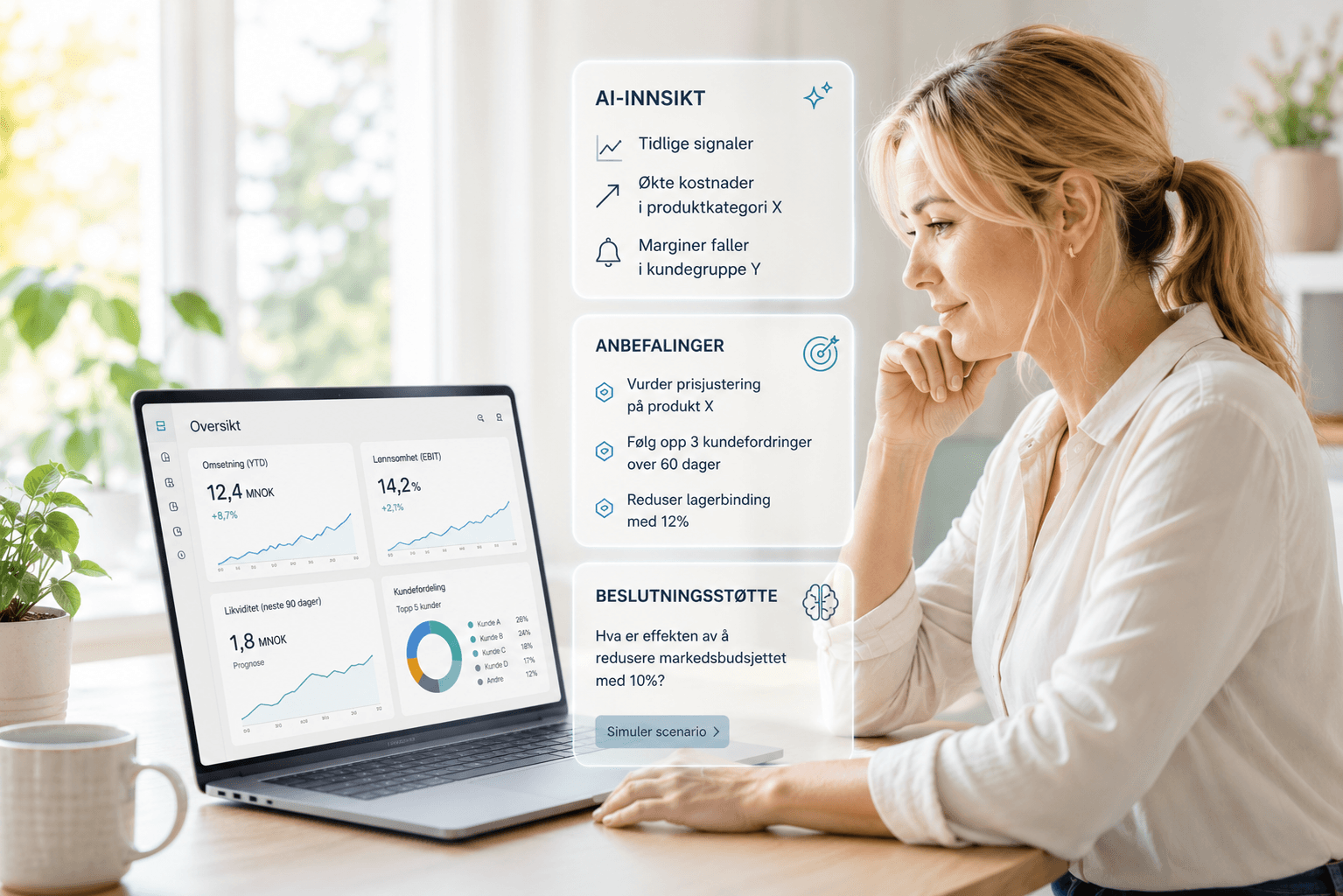
Many still think of financial data as something that summarises the past. But financial data can also be an early warning system.
Small changes in margins, cash flow, accounts receivable or cost development can be the first signals that something is about to happen. Businesses that spot these signals early get more room to act. They can adjust course before problems grow large.
That is a fundamentally different way of using financial data than simply reporting what has already happened.
This is not just about the CEO
When the decision-making basis improves, everyone around the business benefits.
The board can discuss strategy instead of history. The accountant can be an advisor, not just a report provider. Investors gain more confidence in their decisions. Leaders get more time to develop the business, and less time spent searching for answers.
Good financial insight is therefore not a leadership tool. It is a shared basis for decisions.
What does this mean in practice?
Perhaps the most important lesson from the research is that AI should not be the goal. The goal is better decisions.
That means when you evaluate new technology, you might want to ask a different question than "how many hours can this save us?"
Ask instead: "Will this help us make better decisions about our business?"
That is the difference between streamlining yesterday and building tomorrow's competitive strength.
If AI's main purpose is to help businesses make better decisions, which decisions are Norwegian SMEs currently making on too weak a basis?
More posts
AI is ready. Are you?
The question is no longer just what AI can do, but whether we trust what it does. BCG turns the problem on its head: good AI governance shouldn't make AI harder to use, it should make it possible to use more of it, safely.
Your AI is not the problem
OpenAI's chief scientist is warning against recursive self-improvement. Anthropic reports that Claude now writes more than 80 percent of its own code. But this isn't about the AI assistant you use at work, it's about something else entirely, and the difference matters.
Get new analyses in your inbox
One new post a week, never more. No product ads.
Curious about how Capassa works in practice?
Get in touch