
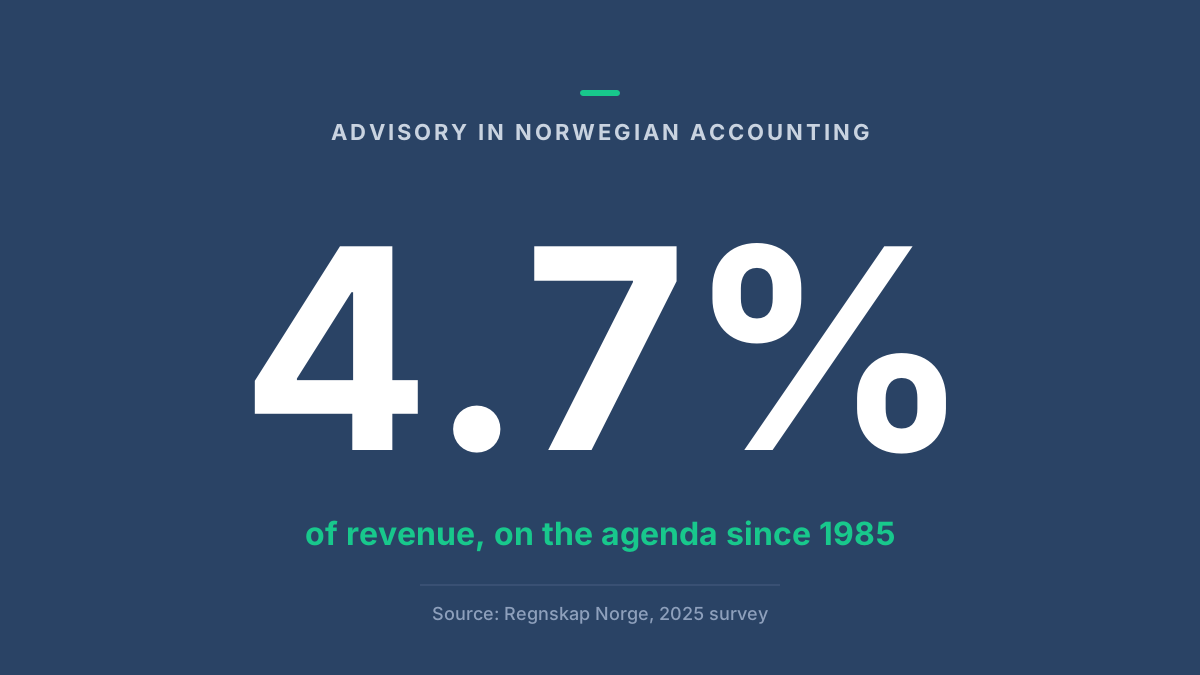
Over 40 years of advisory on the agenda. Just 4.7% of revenue.

Marit Wetterhus
CEO
It's hard to find an industry that has been as unanimous about its own future as the accounting profession. For years, the message has been the same: Bookkeeping will be automated, the accountant will become an advisor, and value creation will shift from producing accounts to developing the client's business. It's not a new message. In a look back at its own history from 2020, Regnskap Norge, the Norwegian association for accounting firms, notes that its member magazine wrote as early as 1985 that "consulting is becoming more and more important" for accounting firms. Regnskap Norge itself observed that the text could just as well have been written today.
Then comes the number. In Regnskap Norge's survey of its member firms, advisory accounted for 4.7 percent of revenue in 2025. The rest came mainly from accounting and bookkeeping (65.2 percent), year-end accounts and tax returns (15.1 percent) and payroll and HR (10.8 percent), 91 percent in total. That isn't necessarily a sign that the profession has failed. But it is a clear sign that the financial reality still looks quite different from the ambitions.
The closer to the invoice, the less advisory
The figure has been higher before. Regnskap Norge's own surveys showed that advisory accounted for 7.5 percent of revenue in 2018 and 8.0 percent in 2022, which they themselves described as the share having practically stood still. But the figures can't be compared directly. Until 2023, firms were asked to split their revenue in percentages. Since 2024, they have split it in kroner. Regnskap Norge itself points out that a percentage split doesn't necessarily reflect what is actually invoiced, and that it can be hard to draw a line between advisory and accounting. My reading is that advisory has taken up more space in the profession's self-image than on its invoices. Advisory has been on the agenda for more than 40 years, and its share has stayed in single digits.
An industry problem, not a small-firm problem
You might think this only applies to the smallest firms. It doesn't. At firms with 1 employee, advisory accounts for 4.6 percent of revenue in 2025, at firms with 2 to 5 employees 4.6 percent, with 6 to 10 employees 4.4 percent and with 11 to 15 employees 3.8 percent. The share is highest at firms with 16 to 24 employees (6.8 percent) and 25 to 49 employees (6.1 percent), while at firms with 50 or more employees it is 4.0 percent. None of the size groups is above seven percent. At firms with 16 or more employees, sales of software and systems also make up more than advisory (7.7, 6.9 and 4.5 percent). That suggests advisory isn't primarily about size, but about how the service is defined, priced and delivered.
Advisory has been a goal. Has it been a business?
I think we need to start distinguishing between wanting to deliver more advisory and building a business that actually makes money from advisory. The first is an ambition. The second requires a business model with clients, content, delivery and pricing. Yet we often talk about advisory as if it will grow by itself, as long as we automate enough bookkeeping. But freed-up time is not the same as new revenue. Regnskap Norge's own analysis also points to what's at stake: Advisory is associated with a lower payroll cost ratio and a higher profit margin, which they believe may indicate better margins and a higher price per hour.
Clients don't necessarily buy "advisory". They buy help improving profitability, getting control of liquidity, assessing investments or understanding what steps to take before problems grow large. These are concrete needs, and concrete needs can be turned into concrete services.
Maybe we need to stop selling hours
Regnskap Norge's surveys indicate that around 60 percent of the industry's revenue comes from hourly pricing models and 24 percent from fixed prices. If value is still measured in hours, efficiency becomes a revenue problem. A good advisory conversation doesn't need to take many hours to be valuable. It isn't the time the advisor spends that determines the value. It's what the client can do differently after the conversation. That requires accounting firms to dare to price advisory as a service with its own value, not as a few extra hours on the invoice.
Technology can increasingly take over the work that used to make advisory expensive to deliver: analyses, deviations, risk and proposed actions. At Capassa, we've built Capa, an AI CFO, for exactly this. But technology doesn't create a new business model by itself. That's up to the accounting firms.
What should the next few years be used for?
I don't think the accounting profession needs more reminders that advisory is important. It has heard that since 1985. What it needs is to make advisory a measurable part of the business. Not just measuring the number of clients, revenue per employee and efficiency in accounting production, but also how many clients actually receive ongoing advice, what they pay for it, and what value it creates. Because 4.7 percent is not a law of nature. It's a picture of how the profession makes money today.
The question is no longer whether advisory is the future. The question is when advisory will start showing up in the accounts.
The figures come from Regnskap Norge's annual survey of its member firms (2025, revenue split in kroner). They are self-reported and refer to classified revenue, not necessarily all advisory work carried out. The number of firms varies between size groups. At firms with 50 or more employees, 30 percent of revenue is classified as "other".
More posts
The accountants on stage in London were sure AI is no threat. What if they're wrong?
On stage at the Digital Accountancy Show in London, accountants said AI isn't good enough, and a founder said they should be extremely worried. Both were certain, in front of a packed room. The founder's most important point wasn't the prediction, but that it's the client who decides whether she wants an accountant.
Maybe we don't need the PDF after all
An accountant asked for a PDF of a chart. Our answer started with a question about what she'd use it for, and ended with a right-click. The story shows what happens when technology doesn't just make old work faster, but changes what the human spends their time on.
Get new analyses in your inbox
One new post a week, never more. No product ads.
Curious about how Capassa works in practice?
Get in touch