
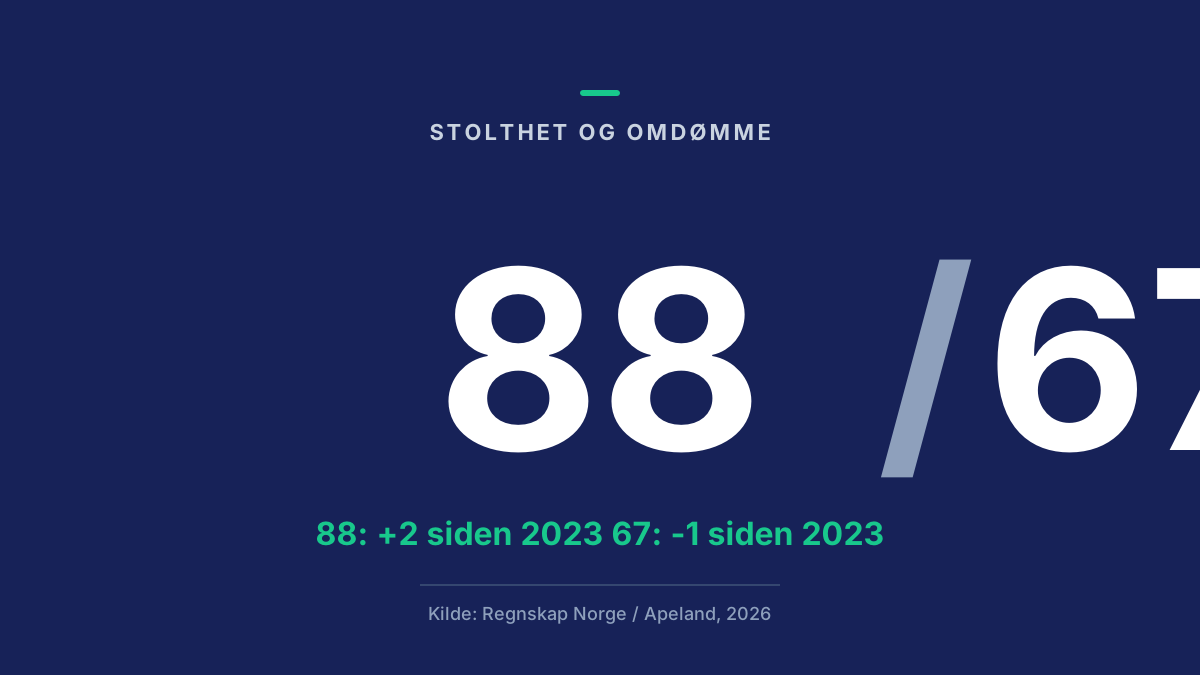
Pride is rising faster than recognition: 88 versus 67

Marit Wetterhus
CEO
A 21-point gap — pointing in opposite directions
Two figures from the same survey deserve to be placed side by side. The reputation study by Regnskap Norge and Apeland, published in August 2026, gives the accounting industry 67 out of 100 points among the general public — one point lower than in 2023. At the same time, members rate themselves at 88 points, up two points from the previous measurement (Regnskap Norge / Apeland).
The distance is 21 points. That it exists is no surprise — most professions rate themselves higher than the outside world does.
The direction is what matters. The internal curve is rising. The external one is drifting slightly down. The drop from 68 to 67 is small enough on its own to resemble measurement noise. What counts is that the number does not move at all during a period in which the industry itself experiences clear progress.
Pride is an internal measurement. It does not register automatically outside the industry.
Familiarity is not the bottleneck
An obvious explanation would be that the market does not know the industry well enough. That explanation holds up poorly. 85 per cent of the population say they know the accounting industry somewhat or well (Regnskap Norge / Apeland).
The market knows who the industry is. It simply has not changed its view of what the industry delivers.
That shifts the question from visibility to substance. When familiarity is high and the rating is flat, more exposure is not what is missing. Something concrete has to have changed for the recipient.
Six out of ten sit in the same category four years later
Regnskap Norge has surveyed its member firms annually since 2022. One of the most telling findings: six out of ten firms are in the same performance category four years later, and jumps from the lowest to the highest level are very rare (Regnskap Norge's industry survey).
Four years is a long time in an industry that has spent the period talking about automation, AI and the shift towards advisory services. Yet positions remain remarkably stable.
That says something precise: performance level is not set by annual ambitions, but by structures. The composition of the client portfolio, the pricing model, the workflow, the quality of the underlying data. Such things rarely change because management decides to improve.
Read the two findings together and the picture sharpens: an industry growing steadily more satisfied with itself, while the actual distribution of performance barely moves.
Advisory work that does not show up in the client's numbers never gets priced
This is where Capassa sees the decisive link.
Advisory work is priced according to what the client can see. And what the client sees with certainty is the invoice. The effect — the liquidity that did not break down in March, the margin that improved by two points, the investment postponed a quarter because the numbers said wait — sits in the client's own accounts. But it is rarely retrieved, and even more rarely attributed to the advice that triggered it.
Without that link, advisory work is a claim. Claims are priced as hours.
This is the same mechanism keeping the reputation score at 67. The industry knows what it has contributed. The client has not had it documented in their own figures, and therefore assesses the delivery much as before.
The industry measures itself better than it measures the client
One detail in the survey is worth dwelling on: from 2024 onwards, the distribution of revenue per service area is reported in kroner (Regnskap Norge's industry survey).
The industry has, in other words, acquired a precise monetary overview of what it sells.
The asymmetry is striking. A firm today can often state how many kroner advisory services generate in revenue. Far fewer can state how many kroner the advice has generated for the client. The first number is internal accounting. The second is the only one that confers pricing power.
Documented impact is a data structure before it is a story
Documented client impact sounds like communication. It is not. It is a data structure.
It requires four things to be in place before the advice is given, not afterwards: a baseline measured before the intervention, a defined metric, the same metric tracked over time, and the figure taken from the client's own books — not from the firm's description of its own work.
This is precisely the kind of work automation and AI make cheap enough to scale. The raw material already sits in the bookkeeping. The cost has historically been in extraction, normalisation and follow-up over time.
And here is an observation about how the technology has actually been adopted: much of the investment in the industry has gone into producing the same delivery more cheaply. That moves the margin. It does not move the price. The price moves only when the client can see what has changed in their own numbers.
The pricing window in 2027
Price adjustments are in practice negotiated during the budget rounds the autumn before. A firm entering that conversation with two extra points of self-confidence holds no better card than the year before. Self-confidence is not an argument the counterparty can verify.
A firm that can present the development in concrete key figures across a selection of clients, over a defined period, has something qualitatively different — a basis that is not a claim about value, but a measurement of it.
It is also the only realistic route out of the stability in performance categories. If the six-out-of-ten figure is to change, something in the structure has to change — not something in the self-image.
Pride is an internal measurement. Price is an external one. Only one of them pays salaries.
More posts
AI has spread beyond accounting: the firm's fight for position toward 2027
The SSB numbers get read everywhere as evidence that AI use is rising. Read as a map of who owns the AI agenda inside Norwegian businesses, they say something more precise: accounting was the entry point in 2023, but by 2026 AI has more home turf in the business than the firm does.
As the AI gap widens, the firm becomes the client's AI department
SSB documents that the gap in AI use between large and small firms widened in 2026. Read as a market signal, this isn't the SMB's problem. It's the clearest description yet of a service market the accounting industry already holds the raw materials for.
Get new analyses in your inbox
One new post a week, never more. No product ads.
Curious about how Capassa works in practice?
Get in touch