
Trust Is Not a Business Model – Accounting's 2027 Choice

Marit Wetterhus
CEO
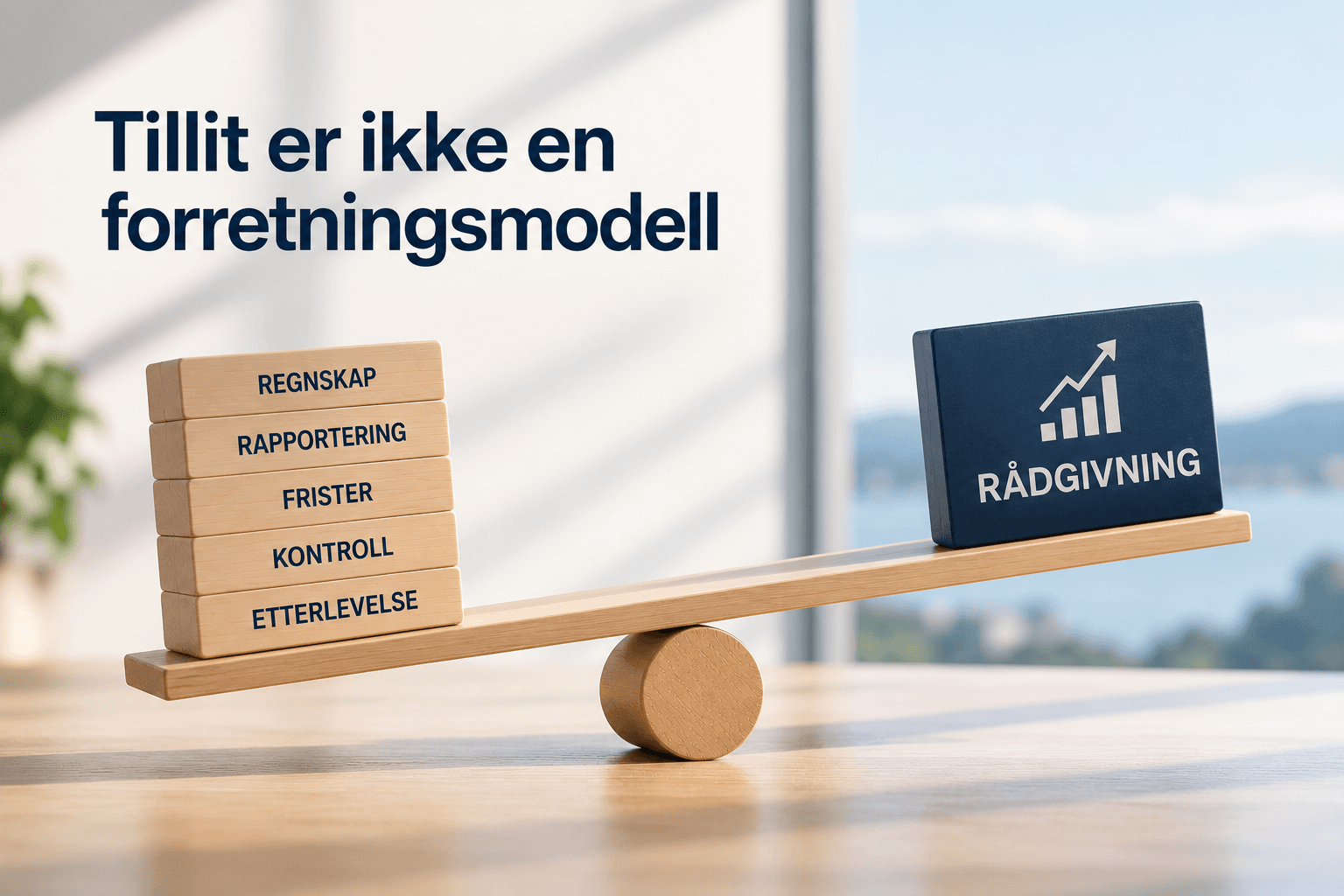
In August 2026, Regnskap Norge published an industry and population survey with a message the profession has every reason to like: its reputation among the public is holding firm, and pride among those working in the industry is rising (Regnskap Norge). Økonomi24 covered the same findings independently, reaching the same headline conclusion about a stable and strong reputation (Økonomi24).
This is being read as good news. Capassa reads it as a balance sheet item.
Reputation is a stock, not an income
Trust is a stock built up over decades: through authorisation schemes, deadlines that are met, numbers that add up, and a professional role local business has learned to rely on. Stocks have one particular property: they yield nothing on their own. They yield when put to work.
In most accounting firms' books, trust does exactly one thing today: it lowers the cost of selling what the firm already sells. The client arrives on a recommendation, negotiates little, stays long. That is real and valuable – but it is trust used as a discount on your own marketing, not trust priced into a product.
That is the difference between having a good reputation and earning money from it. The survey documents the first. It says nothing about the second.
The other curve, the one clients are sitting on
Meanwhile, something is happening on the client side. The report from Samfunnsøkonomisk Analyse for NHO shows that the use of artificial intelligence in Norwegian business has doubled in two years (NHO).
That is the most underrated sentence for the accounting profession in 2026. Not because AI threatens bookkeeping – that is an old debate – but because it changes who the client asks first.
Historically, the accountant's position of trust rested on an information asymmetry. The client could not assess the quality of the work, and therefore bought trust in whoever performed it. That asymmetry is thinning out in one particular layer: the layer where a client has a question and needs an answer.
Questions about deductibility, about how the margin is developing, about what the numbers mean for next quarter – the client now gets a usable first answer without calling anyone. Not a correct answer every time. But a fast, free and confident one.
Answers have become cheap. Accountability has not
Here lies the sharpest way to divide the profession's services right now: the distinction between answers and accountability.
Answers have become a commodity. Accountability – someone who has assessed the client's actual figures, who knows the history, who signs, who is still standing there when the tax authorities ask questions, who says what is unwise rather than merely what is permitted – has not been automated away. On the contrary, it grows more valuable the more confident and fallible the client's own AI becomes.
The problem is that most firms today price the answers and give away the accountability. The advisory work happens, but it happens in unbilled phone calls, in coffee breaks around the annual accounts, as an invisible part of a fixed fee set for production.
As long as advice is free, it is also invisible. And what is invisible can be replaced by the client without anyone noticing something disappeared.
Pride is a recruitment currency with a short shelf life
That pride within the industry is rising is the part of the survey that deserves the most attention – and the part most exposed.
Pride is a lagging indicator of what the role contains. It rises when the working day holds more judgement and less data entry. Automation has given the profession precisely that in recent years, and the survey most likely captures that movement.
But the effect is not self-sustaining. It holds only if the time freed up actually goes into client dialogue, analysis and professional depth – and not into more clients inside the same volume production. A firm that automates in order to raise the number of clients per employee without changing what those employees do is converting pride into capacity.
That is a trade that looks profitable in year one and shows up in the turnover figures in year three. The recruitment market in this industry is tight enough to make it an expensive mistake.
Why the 2027 budget is the real answer
Budgets for 2027 are being written now. That is where the August survey either turns into something, or remains a pleasant press release.
Capassa's reading is that the conversion does not happen in the marketing, but in the service catalogue and the price list. Trust becomes profitability the moment an advisory deliverable acquires a name, a content, a delivery frequency and a price the client can see – not when the firm describes itself as an adviser on its website.
That gives a few quite concrete indicators for assessing a firm heading into 2027, regardless of what it says about its own strategy:
The share of revenue that is not hourly-billed production. Not the ambition – the figure in last year's accounts.
Whether the advisory work has an SKU. A name and a price, or merely good intentions.
Who the client asks first. Whether the firm is point one, or point two after the client has checked with its own AI.
The expiry date
Reputation surveys move slowly. That is why they are comfortable to read – and why they are dangerous to rest on. An industry can lose position for years before the trust figures react, because trust measures what people remember, not what they just did.
A doubling of AI use in two years (NHO) moves faster than that. When two curves of such different speed cross, it is not the slow one that wins.
The profession holds something most industries pay dearly to build, and that no language model can copy: being believed. The survey confirms the capital is there (Regnskap Norge).
The question the next survey will really answer is not whether trust is still high. It is whether anyone managed to price it in before clients stopped asking.
More posts
The accountants on stage in London were sure AI is no threat. What if they're wrong?
On stage at the Digital Accountancy Show in London, accountants said AI isn't good enough, and a founder said they should be extremely worried. Both were certain, in front of a packed room. The founder's most important point wasn't the prediction, but that it's the client who decides whether she wants an accountant.
Maybe we don't need the PDF after all
An accountant asked for a PDF of a chart. Our answer started with a question about what she'd use it for, and ended with a right-click. The story shows what happens when technology doesn't just make old work faster, but changes what the human spends their time on.
Get new analyses in your inbox
One new post a week, never more. No product ads.
Curious about how Capassa works in practice?
Get in touch