
We're using AI the way we used the internet in the beginning


Marit Wetterhus og Aage Thorsen
CEO · Chief Technology Officer
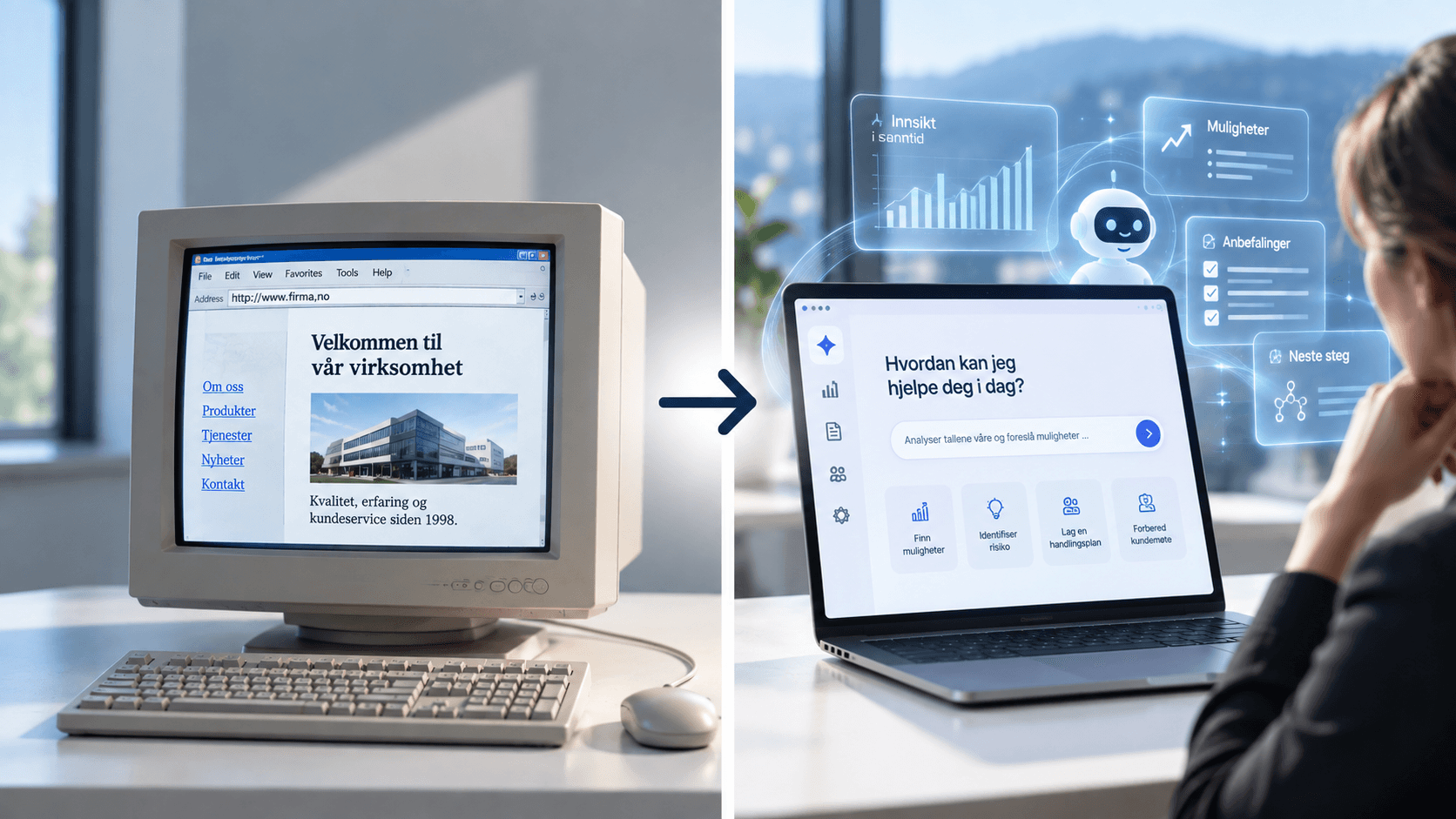
When the internet arrived, most organizations knew they had to be there. The only question was what to actually use it for. The answer was usually fairly simple. They took what they already had and put it online. Brochures became PDFs, and product catalogs went digital. And we thought it was fantastic. And it was.
Information could be distributed faster, cheaper, and to far more people than before. But the business itself stayed largely the same. We'd gotten a new technology and used it to do what we already did, just a bit more efficiently. It took time before most people understood that the internet had opened up a much bigger space of possibility. Suddenly companies could sell directly to customers they'd never met. New marketplaces could connect buyers and sellers. Customers could serve themselves. Entire layers of distribution could disappear, and over time companies and business models emerged that simply hadn't been possible before the internet. What's interesting is that we've seen the same pattern play out several times since. When a new technology arrives, we first use it to improve what we're already doing. Then we start asking the far more interesting question: what can we do now that we couldn't do before?
And now we're standing in the middle of a moment just like that again. This time the technology is called artificial intelligence.
Our era's PDF on the internet
We've become more productive. Millions of people now have access to powerful language models. We write emails, build presentations, and summarize analyses in minutes instead of hours. That's a real gain, but we need to pause for a moment and look more closely at what's actually happened. In most places, the human being is still largely doing the same job. The workflow is the same. The organization is the same. We've just placed a very powerful new tool into the old way of working. In many ways, it's our era's PDF on the internet. That doesn't mean it's a bad thing. Far from it. But the danger is believing that this is the transformation.
Because AI opens up something far bigger than writing the same email faster or producing the same analysis in less time. The big question is therefore no longer how AI can make what we already do more efficient. It's whether we're willing to ask ourselves: if we could redesign our business today, with the possibilities AI gives us, would we still organize the work the same way?
There's a difference between using AI and changing the business
This is where the discussion about artificial intelligence starts getting genuinely interesting. Because it's one thing to adopt AI. It's something else entirely to change the business because AI exists. McKinsey points to a similar divide in its fresh State of AI 2026 survey. Only around 6 percent of organizations are considered genuine high performers with AI. What sets them apart isn't primarily access to the technology, but that they redesign their workflows around it instead of layering it on top of existing processes. Among these high performers, the share that has carried out a fundamental redesign of workflows has grown from 55 to nearly 75 percent in a single year. At the same time, 80 percent report increased individual productivity, while only 37 percent say AI has had a positive impact on the organization's EBIT.
That's an interesting contrast. We can become significantly more productive as individuals without that same gain necessarily showing up on the organization's bottom line. And that's a much tougher challenge than teaching employees to use a new tool. Because then it's no longer about working a bit faster. It's about challenging the way work has been done for years.
The real risk might be making the old way more efficient
It's tempting to think that the organization that adopts AI fastest is also the one furthest ahead. I'm not sure it's that simple. Because if AI is used primarily to do existing tasks faster, we can end up becoming very efficient at ways of working that should have been challenged in the first place. We write the report faster without asking whether the report is still the right deliverable. We automate the meeting prep without asking whether the meeting itself should have been organized differently. We produce the same analysis in five minutes instead of five hours, without asking what the recipient actually needs in order to make a decision. It's a more demanding way to look at AI, because the starting point is no longer today's process. The starting point is the outcome we want to create.
If the goal is for a leader to spot a problem earlier, the question isn't how AI can produce the existing monthly report faster. The question is whether the leader should still be waiting for the monthly report at all. If the goal is to give a customer better financial advice, the question isn't how the advisor can prepare for the client meeting in half the time. The question is whether the technology can spot which customer needs the advisor, what has happened, and why it should be raised, before the customer even thinks to ask. That's when we finally move from: "How can AI do this?" to: "Why are we doing this this way at all?" I think that second question is going to matter far more.
We've seen this pattern before
Much of this feels familiar. We've worked with technology through several major shifts. Among other things, we were part of the move from traditional IT infrastructure to cloud-based solutions. Back then, the promise was just as big, but many eventually discovered that if you didn't dare let go of the old way, you could end up running two worlds in parallel. The old didn't disappear just because you'd adopted the new. The biggest opportunities only appeared once people started building for the cloud, rather than simply moving what already existed into it. It's hard not to see the parallel to what's happening now.
This time it's about AI. At first, we make the familiar a little faster. But then comes the uncomfortable, necessary question: if we were starting today, would we organize the work the same way?
For us, that question became very concrete. Once we saw what the new technology made possible, we had to ask ourselves whether we'd actually have built Capassa the same way if we were starting the company today. The answer was a resounding no. And once we had that answer, we also had to be willing to do something about it. Not because we know exactly what the AI-native business of the future will look like. We don't. Things are moving too fast for anyone to credibly claim they have the whole answer. But we do know there's a difference between using new technology to improve what already exists, and letting it challenge how things actually get done. For us, that means, among other things, that the goal isn't to produce a financial report faster. It's also not to produce more analyses just because AI makes each analysis cheaper.
What's interesting is whether the technology can shorten the path from information to decision. Because it's only once something is actually done differently that the technology starts changing the business. And maybe that's exactly the core of this shift. Not chasing the technology for its own sake, but daring to ask the hard questions about how we actually work, and what actually creates value.
We'll have to learn the rest as we go.
More posts
When everything is important, what do you do first?
The to-do list never ends, and AI is only making it longer. When everything feels important, how do you know what to actually do first?
Your budget isn't lying. But is it still telling the truth?
We spend a lot of time building budgets, but few of us ask the question halfway through the year: if you built it again today, would it look the same? A personal reflection on moving from a static budget to a rolling forecast.
Get new analyses in your inbox
One new post a week, never more. No product ads.
Curious about how Capassa works in practice?
Get in touch