
What if you could discuss your budget with an AI CFO while you build it?
Marit Wetterhus
CEO
November is here, and in many Norwegian businesses work on next year's budget is under way. Revenue targets have to be set, costs assessed, investments planned and perhaps more people hired, and the numbers have to add up so the result can be presented to the board before the year is out.
But how much of budgeting is really about making good decisions, and how much is about getting the numbers in place? I believe we have an opportunity to change the way we work with budgets, not because budgets have become less important, but because technology now makes it possible to spend more time on the questions the budget is actually meant to help us answer.
Altinn warns against being too optimistic
On the budgeting pages of Altinn, the Norwegian government's portal for businesses, there's a piece of advice that is as relevant today as when it was written: Many businesses tend to overestimate revenue and underestimate costs.
Altinn recommends using actual figures from the current year's accounts, assessing which changes are coming next year, and building budgets that can be followed up month by month, so you can compare the budget with the actual accounts and catch deviations early. They also point out that the profit and loss budget and the cash flow budget serve different purposes: One shows expected profitability, while the other shows whether the business will have the money to pay its obligations when they fall due.
This is basic financial management, but it isn't necessarily easy to get right in practice. Because it's one thing to set up a budget with 15 percent revenue growth, and something else entirely to assess whether that growth is realistic, what costs it requires and what happens if sales come in lower than expected. That's where the interesting part of budgeting begins.
A budget is full of questions
Imagine you run a business with 20 employees. You've had a good year, and the plan is to keep growing in 2027. You're considering hiring two new people, increasing the marketing budget and investing in a new system.
You know what the investments will cost, but how do they affect profitability? How much does revenue need to grow to justify the new hires? And what happens to liquidity if the new customers take longer to pay than you assumed? These aren't questions a spreadsheet can answer just because you've entered the right formulas, because you need to understand the relationships between the numbers and the business.
Traditionally, that has meant you either need solid financial expertise yourself, have to involve the CFO or ask your accountant for help. It's still valuable to discuss these questions with people who know the business, but now you can get far more help along the way.
What if you could ask while you budget?
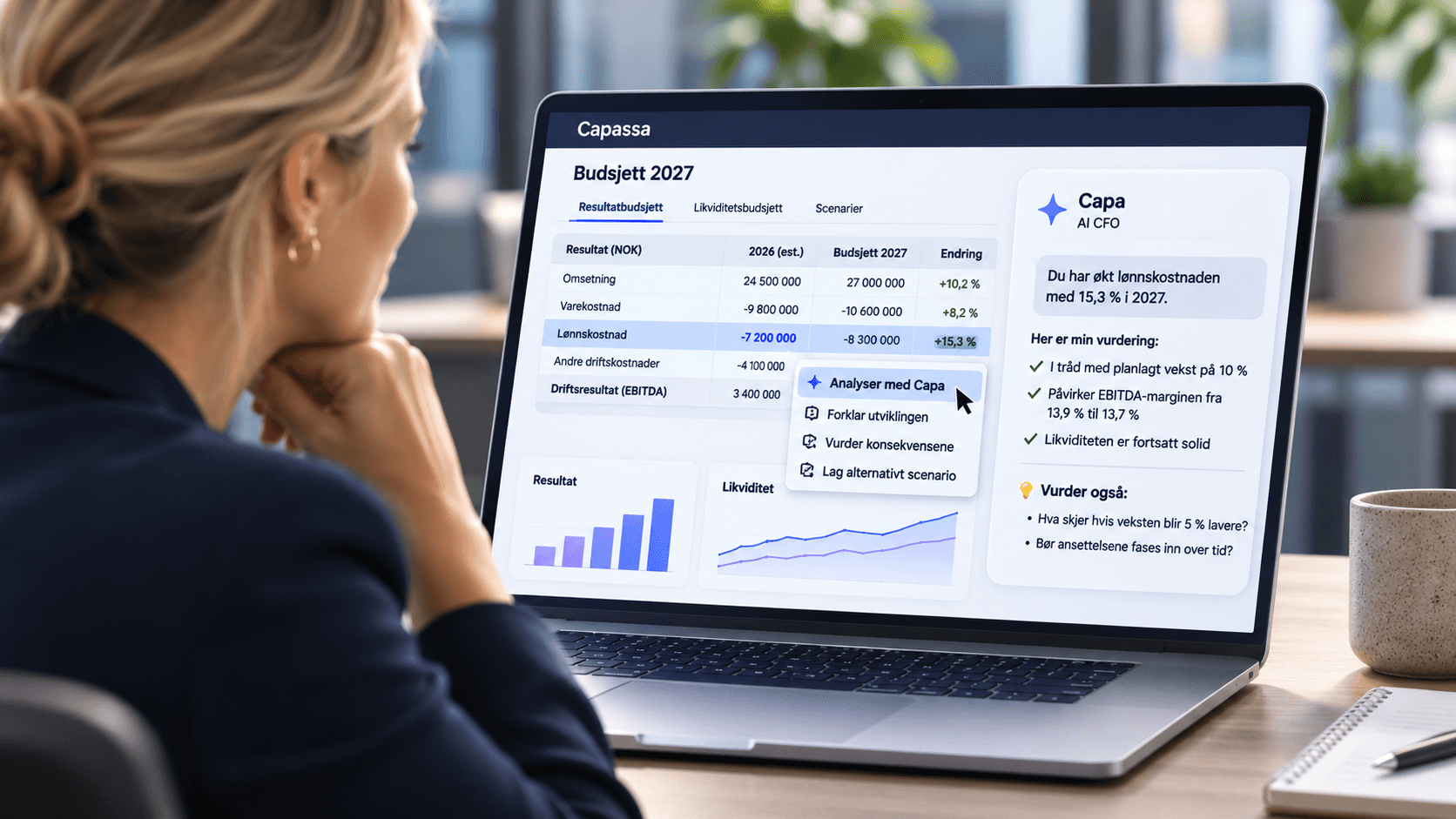
In Capassa, you can create a profit and loss budget and a cash flow budget with a few clicks, build different scenarios and see in charts how changed assumptions affect the finances. But what I find particularly interesting is how our AI CFO, Capa, can be used directly in the budgeting work.
When you have the budget in front of you, you can right-click a budget line and ask Capa to analyse the number, and if you're on a subtotal line, Capa can analyse the whole sum. Capa knows the company you're working with and uses that context to give input and assessments, so you don't need to leave the budget, open another service or explain from scratch which company you're working on. Aage Thorsen, our CTO, has written about why the best AI assistant is the one you don't have to explain everything to.
That means you can get help exactly when the questions come up. Is this cost realistic? What should we be paying attention to? Is there anything in the company's finances that suggests we should think differently?
For a business leader without their own CFO, this can provide access to financial analysis that might otherwise be hard to come by. For a CFO, it can make the work more efficient and provide a better basis for their own assessments. And for an accountant, it can free up time to discuss the client's plans, rather than spending most of the meeting producing the numbers.
Capa isn't meant to make the decisions for you, but to help you ask better questions and understand the consequences before you decide.
One budget is rarely enough
Another challenge with traditional budgeting is that we often end up with a single set of numbers. We pick what we think is the most likely outcome, get the budget approved and move on, even though the future will rarely follow the budget.
Think again about the business with 20 employees. What if revenue comes in 10 percent lower than expected, while the two new hires are already on the payroll? What if the new customers pay later than planned? Or what if you get the chance to grow much faster than the budget allows for?
By building alternative scenarios, you can explore the consequences before they happen, compare the developments in charts and get a clearer picture of which decisions are robust, and which ones depend on almost everything going to plan. You won't necessarily hit every single number more accurately, but you can be far better prepared for reality turning out differently than you expected.
The budget should be the start of a conversation
I think one of the most important things we can do is change how we view what a budget really is. It isn't primarily a document to be finished and approved before Christmas, but a concrete description of what we want to achieve, which assumptions we're building on and what financial consequences our plans may have.
When the budget becomes easier to create, easier to analyse and easier to change, we can spend more time on what matters: discussing the opportunities, understanding the risks and making good decisions. For the accountant, November is therefore a natural time for a budget meeting with each client, where the conversation can be about next year's plans and not just the numbers.
Altinn is quite right that we should be realistic when we budget. But realism isn't just about being cautious with revenue and thorough with costs, it's also about challenging your own assumptions.
The best budget isn't necessarily the one that matches reality most precisely. It's the one that helps you make better decisions when reality changes.
Source: Altinn, Budsjett i driftsfasen (in Norwegian), last updated 23 January 2024.
More posts
We haven't just launched a new website. We've clarified what we believe.
Over the summer we have built a new website for Capassa. It isn't about a prettier design, it's about becoming clearer on what we actually believe.
New integration: Azets Complete Regnskap
Capassa now connects to Azets Complete Regnskap. The system is built on the Unimicro engine, which Capassa already integrates with.
Get new analyses in your inbox
One new post a week, never more. No product ads.
Curious about how Capassa works in practice?
Get in touch