
We knew something was off. Capa found out what.
Marit Wetterhus
CEO
A little while ago we discovered that something was off in our own financial data. We knew there was an error somewhere, but not exactly where it was or what had caused it. So we did what has, by now, become completely natural for us. We handed the problem to Capa, and she found the error, but that wasn't really the interesting part. Capa explained what had happened, why the numbers didn't add up, and what we needed to do to fix it.
It became an important moment for us. Not because a single accounting error is particularly dramatic, but because it made something very clear: the value of an AI CFO doesn't primarily lie in how good the answers are that it can give. The value lies in what it can discover, understand, and help you do something about. And that has shaped how we're now building Capa.
The problem with AI is that you often have to know what to ask
Much of the AI we use today starts the same way, an empty field and "What can I help you with?" It's powerful that we can ask questions, upload documents, analyze information, and ask the AI to look into almost anything. But there's a fairly significant limitation built into that model. You have to know what to ask about.
If I don't know that the margin on part of the business has started falling, why would I ask about it? If I haven't noticed that a cost is developing abnormally, why would I look into it? If liquidity is gradually weakening but still looks fine today, what would make me ask what things look like in three months? And if there's an error in the accounts that no one has discovered yet, no one is going to type: "Can you find the error I don't know I have?"
This is where we believe an AI CFO needs to do something more. It has to pay attention on its own.
A good CFO doesn't wait for the right question
Think about how a good CFO actually works. She doesn't sit in her office waiting for the CEO to walk in and ask the perfect question. She keeps an eye on the business. She notices when margins start moving the wrong way. She reacts when costs develop differently than expected. She sees that liquidity could get tighter a few months out. She notices when the budget and reality start drifting apart. And she doesn't just show up with a red flag.
She says: this is what happened. This is probably why. This is what it could mean. This is what I think we should do. And the job doesn't necessarily stop there.
She follows up.
Was the fix carried out? Did the problem go away? Did the margin develop as expected? Did liquidity improve? That's the way of working we're building into Capa.
From signal to action, and back again
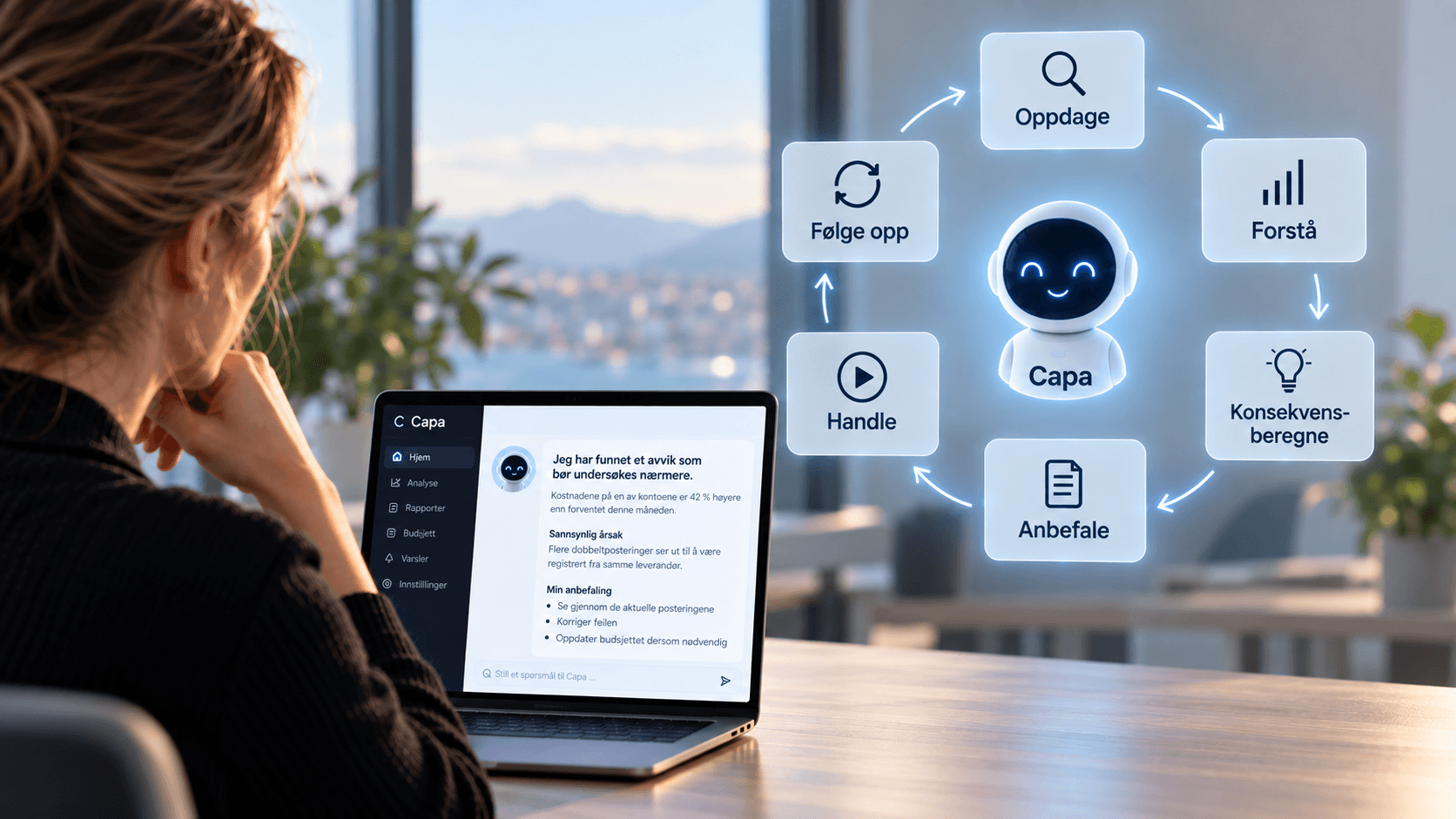
We've therefore started thinking about Capa as a continuous workflow: DISCOVER → UNDERSTAND → ASSESS CONSEQUENCES → RECOMMEND → ACT → FOLLOW UP
But this isn't a straight line, it's a loop. Capa discovers something in the finances. She tries to understand what happened and why. Then she assesses what it could mean for the business, for the result, the margins, the liquidity, the budget, or other relevant figures.
Then comes the question: what should we do about it?
Capa can recommend an action. Over time, we also want Capassa, wherever it's appropriate and safe, to be able to help the user move from recommendation to action. And then comes perhaps the part I find most interesting of all: Capa keeps paying attention. Did the fix work? Is the situation resolved? Has something else changed? If not, the loop starts again.
Discover. Understand. Assess consequences. Recommend. Act. Follow up. And then discover again. That's quite different from producing a report once a month.
Finding the error is only the beginning
Technology that can find anomalies already exists, and there's going to be a lot more of it. Accounting systems will get better at catching errors. Dashboards can flag numbers that move outside an expected range. AI can identify anomalies in large volumes of data, and that's good. But a red flag isn't a decision. Imagine Capa discovers that the gross margin has fallen significantly over the past three months.
The first question is obviously: what happened?
But after that come the far more interesting questions.
- Why did it happen?
- Which products, customers, or costs are driving the change?
- If the trend continues, what does that mean for the result by year-end?
- What does it do to liquidity?
- Is this a temporary blip or the start of a trend?
And most importantly: what should we do now? That's why we don't want to build an anomaly engine that just finds things. We're building a financial workflow that helps you get from signal to action.
And it's not only about finding errors
I think this matters. Because when we say "deviation," it's easy to think of something negative. But financial data constantly contains signals about both problems and opportunities. A customer segment might suddenly be growing faster than the rest. Margins might be improving. Cash flow might make it possible to invest earlier than planned. A business might have more financial headroom than leadership realizes. Sales might be developing far better than budgeted, while at the same time creating an upcoming liquidity need.
So the question Capa asks shouldn't just be: "Is something wrong here?"
It should be: "Is there something here leadership should know about, or do something about?"
That's a meaningful difference.
For accounting firms, this gets even more interesting
A CEO might have one company to keep an eye on. An accountant can be responsible for a great many clients. An accounting firm can have hundreds, or thousands, of businesses in its portfolio. No human can continuously analyze all of those companies. That also means advisory work often starts too late. The client gets in touch once she's already discovered the problem. Or the accountant notices something because she happens to be working on that particular client that day.
But what if the technology could flip that around? Picture coming into work on a Monday morning and Capa saying: 11 clients need attention. Four of them you should contact now. One is seeing falling margins. Another's liquidity is developing more weakly than expected. A third has a cost trend that differs significantly from previous months. And a fourth is growing so fast it might be time to discuss financing and liquidity needs. At that point, AI has done something far more interesting than automating bookkeeping. It has figured out where the human can create the most value.
Maybe this is how proactive advisory actually scales
The accounting industry has been talking about more advisory work for years. But there's a practical problem that often gets underestimated. Someone has to know who to contact. Someone has to know why. Someone has to know what to talk to the client about. And it has to be possible to do that across a client portfolio far too large for each company to be analyzed manually every week. This is where I think AI can change advisory work more fundamentally than we've talked about so far. Not by replacing the advisor. But by making the entire portfolio analyzable. The technology can keep an eye on everyone. The human can spend their time where it's actually needed.
We're not building Capa to be yet another chatbot
This experience has also made us clearer about what we don't want to compete on. There's going to be AI chat in nearly every accounting system. There are going to be dashboards, report generators, agents, and anomaly detection. Much of that is eventually going to become standard. We believe Capassa needs to sit somewhere else. The accounting system should produce and structure the financial data. Capa should keep watch over it, understand what it means, and help the business or the advisor move forward. Discover → understand → assess consequences → recommend → act → follow up. And then it starts again. There's still a lot we need to build before this loop works the way we want it to in every situation. But the small error we found in our own numbers made the direction very concrete for me.
The most interesting part wasn't that Capa found an error. It was that she found something that needed attention, explained why, and helped us move toward what we should do about it.
That's the AI CFO we're building.
More posts
AI is ready. Are you?
The question is no longer just what AI can do, but whether we trust what it does. BCG turns the problem on its head: good AI governance shouldn't make AI harder to use, it should make it possible to use more of it, safely.
Your AI is not the problem
OpenAI's chief scientist is warning against recursive self-improvement. Anthropic reports that Claude now writes more than 80 percent of its own code. But this isn't about the AI assistant you use at work, it's about something else entirely, and the difference matters.
Get new analyses in your inbox
One new post a week, never more. No product ads.
Curious about how Capassa works in practice?
Get in touch