
You can now talk to your budget. And have Capa make the changes for you.
Marit Wetterhus
CEO
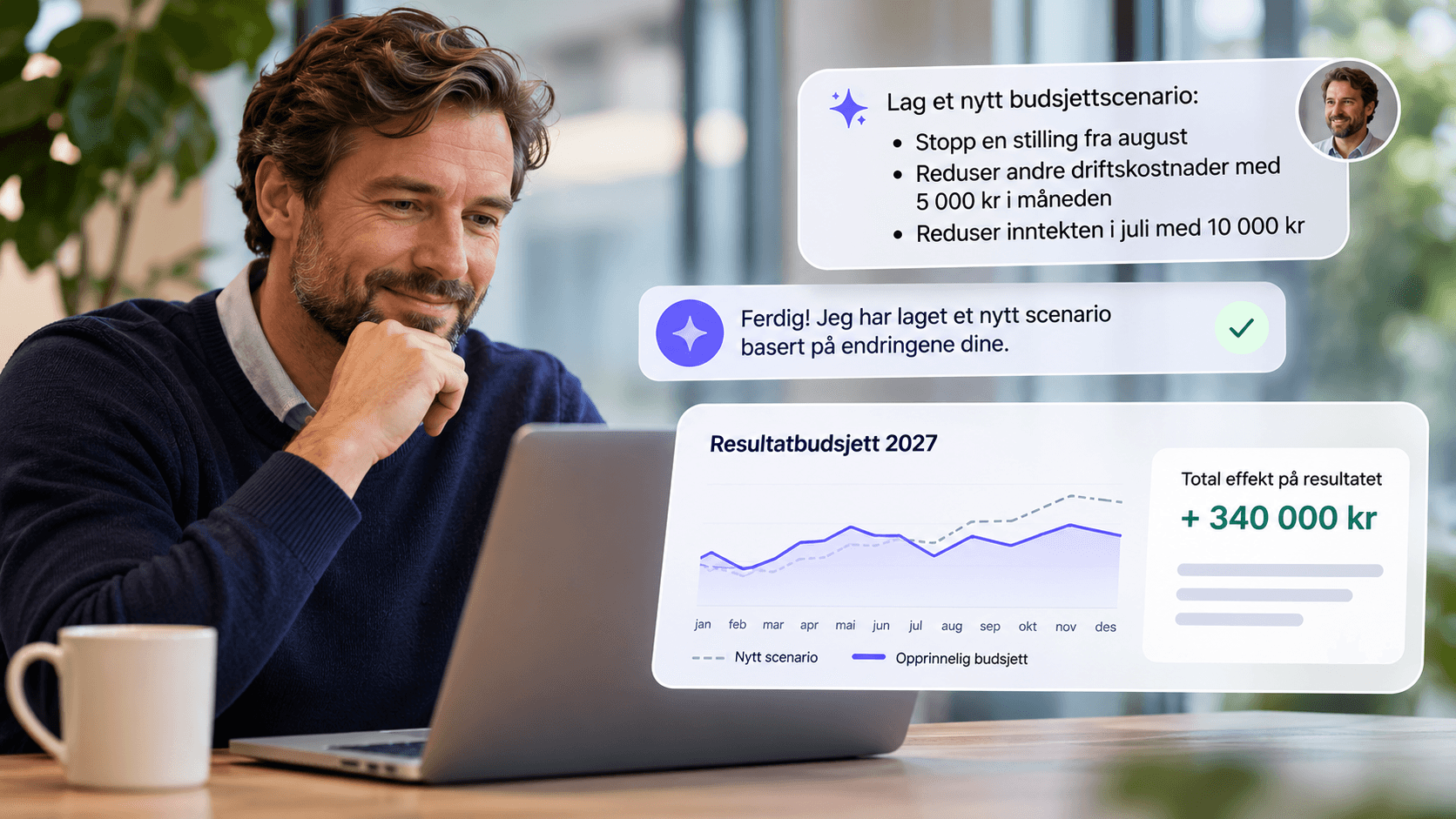
"We're considering hiring two new people from March. What will that mean for our result next year?"
You're sitting with the 2027 profit and loss budget in front of you, and you put the question to Capa, our AI CFO. Capa knows your company, the accounting history and the budget, analyses how the hires could affect costs and the result, and helps you clarify the assumptions.
Then comes the part I think is the best. Capa asks whether you'd like it to make the changes to the budget for you. You say yes, and Capa creates a new scenario with the updated numbers.
But then you start thinking further. What if we also raise prices from April? And what if revenue comes in a little lower than expected over the summer months? You keep the conversation going, and Capa updates the scenario with the new assumptions. Maybe you also want to see what happens if you postpone one of the hires until June. One more change and one more update, and all the while you can see how the decisions together affect the budget.
You're no longer discussing a budget someone has to update after the meeting. You're developing the budget while the discussion is happening.
From spreadsheet to conversation
I've worked with budgets for many years, and I know how much work can go into a good budget, and how quickly it can become outdated. A big customer postpones a project, a new opportunity comes up, or we consider hiring more people, investing in new equipment or raising prices. Suddenly we need a new version, and that often means another round of spreadsheets, calculations and meetings.
With Capa, you can instead discuss the decision with an AI CFO that knows your company, understand the consequences and then ask it to update the budget. Not as a one-off exercise, but every time you're considering something that could affect your finances.
You explore, you decide
When Capa creates a scenario, it doesn't change the current budget. The scenario sits as a proposal you can approve or reject, and you can compare it with the original budget and see the consequences in charts. Maybe you build one scenario where you go on the offensive, with more people and higher expected revenue, and another where you're more cautious, postpone investments and keep costs down.
Earlier versions are kept, so you can go back and see how the plans have developed. And when you've found a scenario you want to use, you decide yourself whether it should become the new profit and loss budget.
Capa helps you explore the possibilities. You make the decision.
But what are the numbers actually based on?
Not long ago I was demonstrating Capassa to a customer. We let Capa build a proposed 2027 profit and loss budget based on the company's own accounts. The budget looked sensible, but the customer asked a question I thought was really good: "What assumptions are actually behind these numbers?"
We put the question straight to Capa. It explained which historical figures the forecast was based on, how seasonal variation affected expected revenue and which cost levels it had carried forward. But it didn't stop there. Capa pointed out that the data history was shorter than it first appeared, identified a month with negative revenue that should be looked into, and explained what it didn't know: whether the company was planning new hires, price increases or larger investments. And those are exactly the kinds of decisions that determine how next year actually turns out.
That's why I think it's so important that an AI CFO can't just build a budget, but also explain what the numbers are based on, make uncertainty visible and help us challenge the assumptions. It's only when we understand the numbers that we can use them to make better decisions.
From analysis to action
We've written before about how you can discuss a budget line with Capa while you work on the budget. Now the conversation can lead to more. You can ask, analyse, challenge and change, until you have a scenario that reflects your plans, without leaving the budgeting work.
That doesn't mean Capa knows everything. It builds on the data available and the assumptions you give it, the calculations have to be verifiable, and a scenario is no guarantee of how the future will turn out. But when technology helps us both understand the consequences and carry out the changes, the business leader can explore new ideas as they come up, the CFO can spend less time producing budget versions and more on weighing the alternatives, and the accountant can use the client conversation for the choices the business should make, not for who's going to update the spreadsheet after the meeting.
It doesn't stop at the profit and loss budget either. A decision can look sensible for the result and still affect liquidity in completely different ways, and what happens to the money in the bank, and when, is at least as important. We'll come back to that.
Maybe it isn't better budgets we need
Maybe we need a better way of working with them. We don't make budgets to produce numbers, but to understand the business, plan for the future and make good decisions, and our plans change all the time. I think we'll look back at much of today's budgeting and wonder why we spent so much time on producing the numbers themselves. Because the most exciting thing about Capa isn't that it can build a budget in a few minutes, but that you can keep discussing the future, explore the alternatives and get help changing the plans along the way.
What if the budget was no longer a document you had to update every time your plans changed, but a conversation you could keep going?
More posts
What if you could discuss your budget with an AI CFO while you build it?
Budget season is under way. Altinn warns against overestimating revenue and underestimating costs, but the hardest part is understanding what the numbers mean for the business. In Capassa, you can right-click a budget line and get an assessment from Capa while you budget, and test scenarios before reality does it for you.
We haven't just launched a new website. We've clarified what we believe.
Over the summer we have built a new website for Capassa. It isn't about a prettier design, it's about becoming clearer on what we actually believe.
Get new analyses in your inbox
One new post a week, never more. No product ads.
Curious about how Capassa works in practice?
Get in touch